


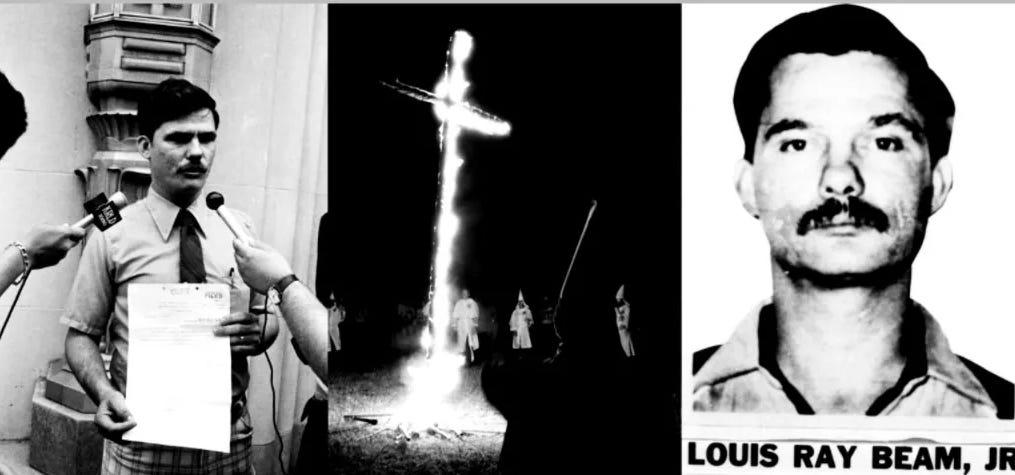
During my 16 years working as a journalist, I’ve spent more than a decade focusing on the far right in the United States and Europe. In the US alone, I’ve covered anti-immigrant militias, Klan outfits, anti-government seditionists, hardline neo-Nazis, accelerationists who believe in lethal violence, and white nationalists who try to massage their beliefs into the mainstream discourse.
Almost inevitably, one name has cropped up in my research time and again: Louis Beam.
A Texan who for a period led the state chapter of the Knights of the Ku Klux Klan, he served in the Vietnam War and spent years in the far-right spotlight. He eventually left the Klan and joined Aryan Nations, a fascist Christian Identity group based in Idaho. In the 1980s, he was one of 14 people put on trial for a host of alleged crimes, including sedition for allegedly planning to overthrow the US government.
For several years, I’ve looked in newspaper archives, university archival repositories, and beyond to better understand his legacy in the white nationalist movement. My new long read about it is now up at Inkstick Media. You can read it here.
He’s also credited with applying the concept of “leaderless resistance” to the American far right: Rather than joining organized, highly visible groups, he advised white nationalists to operate in “phantom cells” in order to create “an intelligence nightmare” for the government.
It was an influential strategy. A former FBI agent who was undercover in neo-Nazi skinhead gangs in the early 1990s told me he saw “leaderless resistance” at work in the movement. A former skinhead told me the same.
Active for more than two decades, Beam largely receded from public view in the late 1990s. Still, many of the strategies and tactics he helped popularize remain relevant today.
As one longtime expert told me, “He redefined violence in the white supremacist movement. He predicted and created the future we’re living in. He’s a big deal for this heinous movement’s trajectory, and he looms large over everything that is happening to us today.”
Recommended Reading
Many academics, experts, and journalists have written about Beam and the movement he was part of, though, and I wanted to share a list of recommended reading, some of which proved invaluable while I was researching and writing my own piece.
Bring the War Home by Kathleen Belew
Dr. Kathleen Belew is one of the leading historians on the white power movement in the United States. In Bring the War Home: The White Power Movement and Paramilitary America (2018), she provides perhaps the most comprehensive and in-depth overview of the movement’s history. In addition to charting Beam’s influence, she follows several other prominent leaders and touches on some of the most pivotal events in the movement’s history: the Ruby Ridge shootout, the Waco siege, and the Oklahoma City bombing, among others.
The Fishermen and the Dragon by Kirk W. Johnson
In The Fishermen and the Dragon: Fear, Greed, and a Fight for Justice on the Gulf Coast (2022), Johnson focuses on Beam and other white supremacists targeting Vietnamese refugees working as fishermen in Texas’s Galveston Bay. It is a thorough, compellingly written, and people-driven work of narrative nonfiction, and it’s well worth reading.
Blood and Politics by Leonard Zeskind
The journalist and activist Leonard Zeskind passed away last year, but he left behind decades of vital work on the white nationalist movement. In Blood and Politics: The History of the White Nationalist Movement from the Margins to the Mainstream (2009), he chronicles the history of violence in that movement and the enduring appeal to some of the ideologies within it.
Other Resources
There are many more, but I don’t want to only suggest books. Several reports and works of journalism are similarly crucial.
The researchers Jon Lewis and Haroro J. Ingraham authored an important and invaluable report titled “Founding Fathers of the Modern American Neo-Nazi Movement,” which examines the legacies and impact of Beam, William Luther Pierce III, and James Mason. This report dives deep into their influence, their leadership styles, and other aspects of their time at the helm of American neo-Nazism.
In 2021, Laura Smith took a hard look at the enduring impact of Louis Beam at the New York Times. It is a superb piece of journalism. Of particular emphasis in this piece is Beam’s idea to use the internet to advance the movement.
In Time magazine, Jacob Ware and Bruce Hoffman also wrote of the way Beam’s fingerprints were still visible in contemporary online extremism in 2024. This piece traces the history from the white nationalism emboldened by social media today to Beam’s Aryan Nations Liberty Net in the 1980s.
Equally helpful were the many, many reported pieces over the decades in newspaper archives. From the 1970s until the 1990s, newspaper reporters around the country covered the movement in general and Beam in particular.
The Southern Poverty Law Center also maintains valuable reportage on Beam and his era. Meanwhile, the University of North Texas’s Portal to Texas History still holds a handful of television news reels from Beam’s travails. As far as resources go, the Portal is an astounding service.
Here are a few examples: In 1981, Bill Hix of the local Channel 5 Action News spoke to Beam outside a federal courthouse in Fort Worth, Texas. In 1987, as Beam was being led into a courthouse in Fort Smith, Arkansas, where he was being tried for sedition, news cameras captured this footage of him. One reporter asked if he had plotted to overthrow the US government. You can see his response here.
All of this is to say, many have written about and reported on Louis Beam, his impact, and his legacy long before I have. I started working on my piece in 2021 while editing and reporting at the Dallas Observer. After I left the Observer, I carried it with me and worked on it periodically. I hope it’s a worthy contribution to what others have already done. Read it here.
Dotted Line is a newsletter focused on global borders and the far right, written by Inkstick Media managing editor Patrick Strickland. If you have tips, email Patrick at pstrickland (at) inkstickmedia (dot) com.
Top photo collage: Image one shows Louis Beam outside a courthouse in 1981 (University of Texas at Arlington Special Collections); image two shows a Ku Klux Klan cross-burning ceremony in Euless, Texas, in 1979 (University of Texas at Arlington/Fort Worth Star-Telegram Collection); and image three shows Louis Beam’s mugshot on the Ten Most Wanted list (FBI).
